
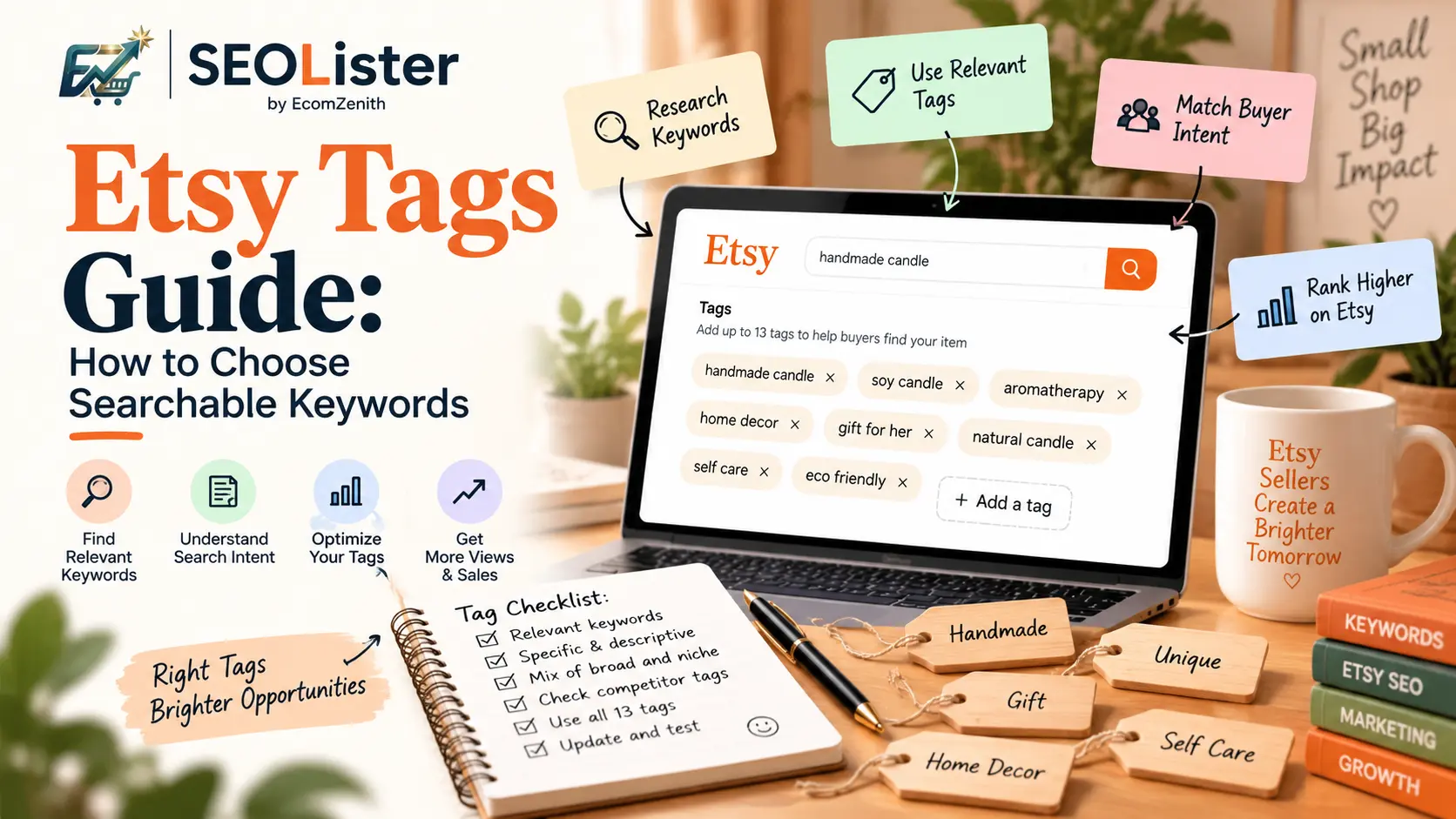
Etsy gives you 13 tags for each listing. The goal isn't to find 13 random keywords and fill every box.
The goal is to use those 13 slots to describe your product in the same language your potential buyers might use when searching.
For the broader strategy, see the Etsy SEO Guide.
What are Etsy tags?
Etsy tags are search phrases you add to a listing to help Etsy understand what your product is relevant to.
A tag can describe more than just the product itself.
Depending on the product, useful tags can describe:
- What the product is
- Who it is for
- Its style
- Material
- Color or design
- Occasion
- Intended use
- A specific type of buyer
For example, instead of using broad tags such as mug or gift, a ceramic mug seller might use more specific phrases such as:
- ceramic coffee mug
- handmade pottery mug
- rustic coffee cup
- personalized mug
- coffee lover gift
The exact tags should depend on the product and the way buyers search for it.
How to choose better Etsy tags
1. Start with the product itself
Before thinking about keywords, describe the product in simple words.
Ask:
What is it?
Who would buy it?
Why would they buy it?
Where or when would they use it?
For example:
Handmade ceramic mug with a blue floral design, made for coffee and tea drinkers.
That basic description gives you several directions for potential tags.
2. Use specific phrases instead of broad words
Broad words can describe thousands of products.
For example:
- mug
- jewelry
- necklace
- gift
- shirt
These don't tell Etsy—or the shopper—much about what makes your product relevant.
A more specific phrase gives the search query more context:
- ceramic coffee mug
- floral ceramic mug
- handmade pottery mug
- personalized coffee mug
Think about the difference between someone searching for "mug" and someone searching for "blue floral ceramic mug."
The second search gives you a much clearer idea of what the buyer wants.
3. Think like the buyer
Don't choose tags only because they sound like good SEO keywords.
Ask yourself:
"If I wanted this product, what would I type into Etsy?"
For a handmade candle, a seller might think about:
- soy candle
- scented candle
- lavender candle
- self care gift
- candle gift set
The best tags usually describe the product from the buyer's point of view—not the seller's internal product terminology.
4. Cover different types of searches
You don't need 13 variations of the same phrase.
Use your available tag space to cover different relevant ways someone could search for the product.
Depending on the listing, consider combinations of:
Product type
- ceramic mug
- wall art
- silver earrings
Style
- minimalist decor
- boho jewelry
- rustic home decor
Material
- sterling silver
- ceramic pottery
- linen apron
Use case
- coffee lover gift
- wedding table decor
- kitchen wall art
Occasion
- birthday gift
- wedding gift
- housewarming gift
Recipient
- gift for mom
- gift for teacher
- gift for bridesmaid
Don't force every category into every listing. Only use phrases that genuinely describe the product.
5. Avoid repeating the same idea
One of the easiest ways to waste your 13 tag slots is by creating tiny variations of the same phrase.
For example:
- ceramic mug
- ceramic coffee mug
- coffee ceramic mug
- handmade ceramic mug
- handmade coffee mug
Some overlap can be natural, but don't spend most of your tag space saying essentially the same thing.
Instead, look for other relevant search intents your product can satisfy.
6. Use long-tail phrases when they make sense
A long-tail keyword is a more specific search phrase.
For example:
mug → ceramic coffee mug → personalized ceramic coffee mug
The more specific phrase can represent a clearer buyer intent.
But don't make phrases unnaturally long just because they contain more words.
A useful rule is:
Specific is good. Forced is not.
Your tags should sound like something a real shopper could search.
7. Keep your tags relevant to the actual product
Never add a popular keyword simply because you think it might bring traffic.
If you sell a ceramic mug, don't add unrelated tags such as:
- wedding dress
- leather wallet
- Christmas ornament
Irrelevant traffic isn't useful, and the tag doesn't accurately describe your listing.
Your goal is relevant searches, not just more searches.
8. Use your title, tags, and attributes together
Your Etsy SEO shouldn't be built around tags alone.
Your title, tags, attributes, categories, and listing content should communicate a consistent understanding of the product.
For example, if your product is a handmade ceramic coffee mug, your listing might naturally cover:
Title:
Handmade Ceramic Coffee Mug, Blue Floral Pottery Cup
Tags:
ceramic coffee mug, handmade pottery mug, floral coffee cup, blue ceramic mug, pottery coffee cup, coffee lover gift, rustic kitchen gift
The important thing is consistency and relevance—not copying the exact same phrase everywhere.
A simple 13-tag checklist
Before publishing a listing, review your tags and ask:
- Is every tag relevant to the product?
- Does each tag represent a realistic search?
- Am I using specific phrases where appropriate?
- Have I covered different buyer intents?
- Have I included relevant style or material terms?
- Have I considered use cases or occasions?
- Am I repeating the same idea too many times?
- Do my tags match the actual product?
- Do my tags work naturally with my title and attributes?
- Have I used all 13 useful tag slots?
If you can answer yes to these questions, your tags are much more likely to be useful than a list of random synonyms.
Common Etsy tag mistakes
Using only broad keywords
Tags like gift, mug, or jewelry can be too generic on their own.
Repeating the same keyword
Using every tag to target almost the same phrase leaves less room to describe other relevant searches.
Adding keywords that don't describe the product
A keyword isn't useful just because it gets searched.
Writing tags for search engines instead of shoppers
If the phrase sounds unnatural and you would never expect a buyer to type it, reconsider it.
Ignoring buyer intent
Think beyond what the product is.
Consider why someone is looking for it.
A shopper may search for:
"gift for coffee lover"
rather than simply:
"ceramic mug"
That difference can help you discover additional relevant tag ideas.
Final takeaway
You get 13 Etsy tags. Treat them as 13 opportunities to explain your product from different relevant search angles.
Start with the product, think like the buyer, use specific phrases, cover different search intents, and avoid filling your tags with repetitive synonyms.
The goal isn't to use the most keywords. It's to use the most useful ones.
Frequently Asked Questions
How many tags should I fill on Etsy?
Use all 13 tags when you can fill them with distinct, relevant search phrases. Avoid leaving useful tag slots empty.
What should I put in my Etsy tags?
Use phrases that describe what the product is, its style, material, occasion, recipient, or intended use—based on how shoppers are likely to search.
Should Etsy tags match my title?
Your tags and title should describe the same product and search intent, but you do not need to repeat the exact same phrase in every tag.
Etsy SEO
The Complete Etsy SEO Guide 2026
Rankings stalling across the shop? Follow this map for keywords, titles, tags, attributes, and photos so every listing has a path to get found.
Etsy SEO
How to Write Etsy Titles That Get Found in 2026
Titles that sound clever but never rank? Learn keyword placement shoppers actually type so your listings show up before competitors do.
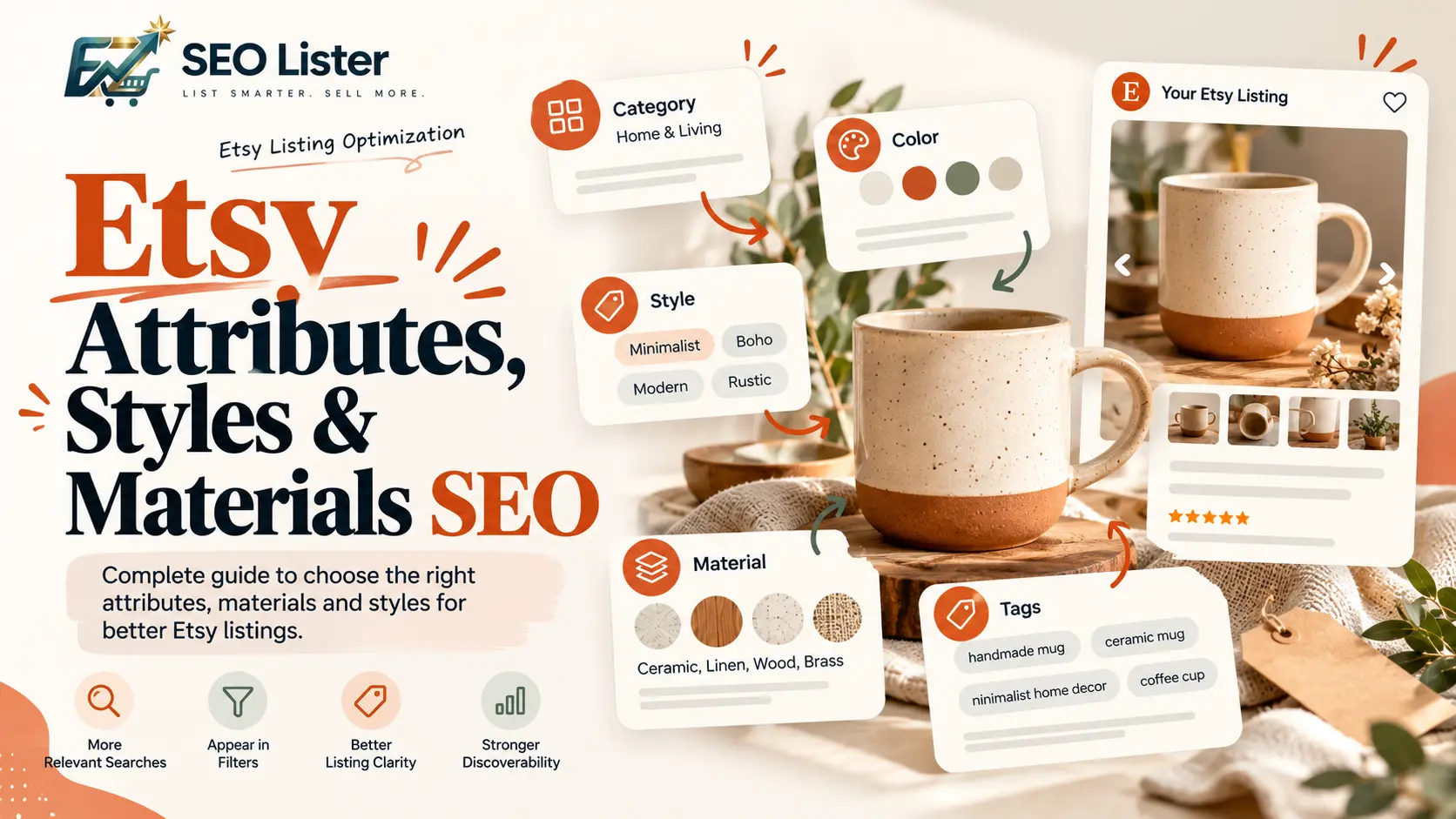
Etsy SEO
Etsy Attributes, Styles & Materials SEO: How to Optimize Your Listings
Learn how Etsy attributes, styles, and materials affect listing discoverability, how they differ from tags, and how to optimize each field accurately.