
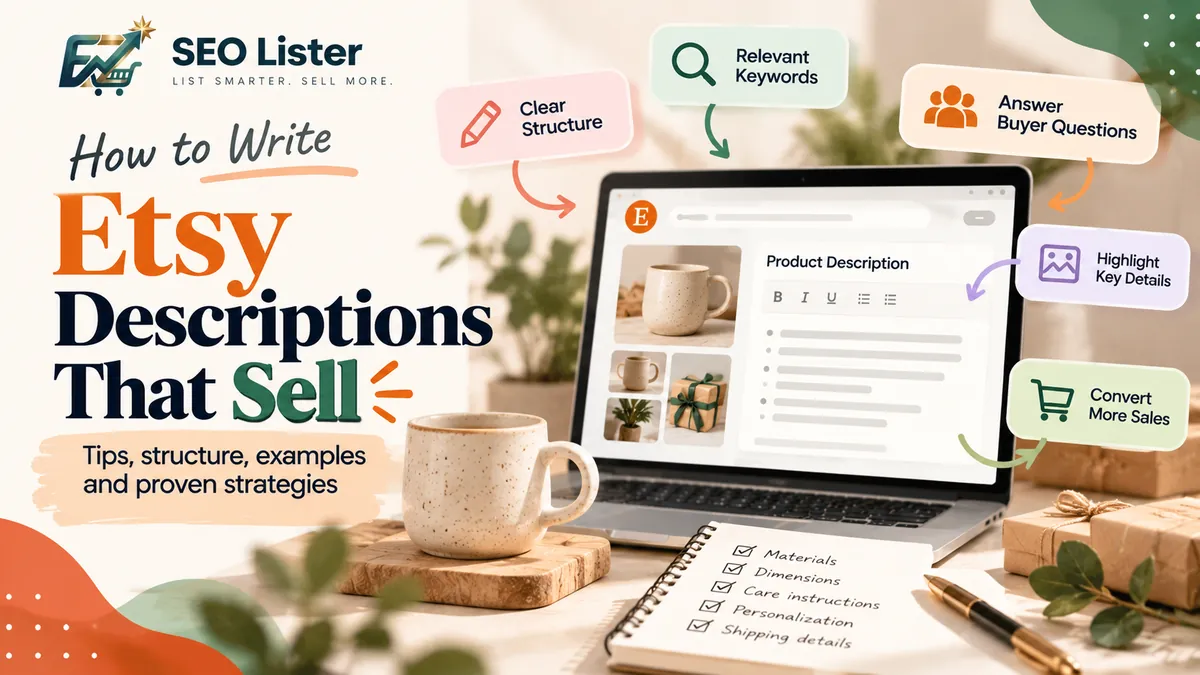
What an Etsy description is for
Your description has two jobs:
Help shoppers decide. Dimensions, materials, finish, what’s included, and how to care for the item reduce returns and hesitation.
Help Etsy understand the product. Extra context that doesn’t fit cleanly in the title, 13 tags, or attribute dropdowns can still live here—written as real sentences, not a dump of synonyms.
It is not a second place to repeat your title 10 times. That pattern is one of the common Etsy SEO mistakes.
Etsy description vs title vs tags vs attributes
| Field | Job | Example |
|---|---|---|
| Title | Product + key traits, easy to scan | Beige Linen Cushion Cover, 18×18 |
| Tags | Distinct buyer search phrases | textured cushion cover |
| Attributes | Structured options (color, material, etc.) | Linen; Beige |
| Description | Details, proof, care, shipping, FAQs | Fabric weight, zipper type, wash instructions |
Keep them consistent. If the attribute says linen, the description should not claim silk. Expand on composition in the description when the attribute alone is too broad—see Etsy attributes SEO.
A proven Etsy description template
Copy this structure and fill it with your product facts:
1. Opening (1–2 sentences)
State what the item is and the main benefit or use.
Handmade beige linen cushion cover for sofas and reading chairs—soft texture, removable cover, 18×18 inches.
2. What’s included / product details
- Size or file format (for digital)
- Materials and finish
- Color notes (photos vs screen)
- Quantity, sets, or matching items
3. How to use / who it’s for
Occasion, room, recipient, or style—only if accurate.
4. Care & personalization
Wash instructions, engraving limits, proofing steps, turnaround for custom work.
5. Shipping & policies
Processing time, shipping regions, returns for personalized items.
6. Optional FAQ block
Answer the 2–3 questions you get in messages most often.
Draft a first pass with the Etsy description generator, then edit every claim for accuracy.
How to use keywords in descriptions (without stuffing)
- Place primary phrases in title and tags first — use the title generator and tag generator.
- In the description, write for humans — mention materials, style, and use cases where they fit a sentence.
- Prefer specificity — “14k gold-filled chain, 18 inches” beats “gold gold jewelry gold necklace.”
- Skip keyword lists at the bottom. They look spammy and rarely help buyers.
- Match attributes — don’t invent materials or occasions just to squeeze a phrase in.
Long-tail language belongs in natural sentences: “Fits a standard 18-inch insert” or “Suitable for everyday wear.”
Examples: weak vs strong description openings
Weak (keyword wall)
Linen cushion cover linen pillow cover beige linen pillow linen sofa cushion decorative linen pillow case gift for her home decor…
Strong (buyer-first)
This beige linen cushion cover softens a sofa or reading nook without looking busy. The removable cover uses a hidden zipper and is sized for an 18×18-inch insert.
The second opening still uses relevant words—linen, beige, cushion cover—while answering what the shopper needs to know.
Digital vs handmade descriptions
Handmade / physical
Emphasize materials, craftsmanship, dimensions, care, and shipping. Call out personalization options clearly so buyers don’t order the wrong variant.
Digital downloads
State file types, dimensions (e.g. 8.5×11 PDF), what’s included, how to download, and software needed. Reminder: no physical item ships. Keyword relevance still matters, but clarity prevents bad reviews.
Creating a full draft from a brief or photos? Use listing from text or listing from image, then polish the description section. Full create flow: How to create a new Etsy listing.
Description checklist before you publish
Use with the Etsy SEO checklist:
- Opening states what the product is in plain language
- Materials / file details are accurate and match attributes
- Size, quantity, or download specs are explicit
- Care or usage instructions are present when needed
- Personalization rules are clear
- Shipping / processing expectations are set
- No keyword list or repeated stuffed phrases
- Description agrees with title, tags, photos, and attributes
- You’ve run the listing analyzer after edits
How SEOLister helps with descriptions
SEOLister can draft titles, tags, descriptions, styles, and materials from product photos or a short brief—so you’re not staring at a blank box. Treat AI output as a starting point: verify materials, sizes, and claims, then publish.
Free tools that fit this workflow:
- Etsy description generator
- Etsy listing analyzer
- Listing generator from text
- Listing generator from image
- Etsy title generator
- Etsy tag generator
- All free Etsy tools
Compare tooling options in Best Etsy SEO tools, or see features and pricing.
Frequently asked questions
Do Etsy descriptions help SEO?
Yes. Descriptions give Etsy and shoppers more product context. They work with titles, tags, attributes, and photos—but stuffing keywords into a wall of text usually hurts clarity more than it helps search.
How long should an Etsy description be?
Long enough to answer buyer questions and cover important details—materials, size, care, shipping, and personalization—without repeating the same keyword. Focus on usefulness, not word count.
Should I put keywords in my Etsy description?
Use relevant language naturally when it describes the product. Do not paste keyword lists or repeat the same phrase. Put primary search phrases in the title and tags first, then expand details in the description.
What should an Etsy description include?
What the item is, key features, materials, dimensions or file details, how to use or care for it, personalization notes, shipping or processing info, and any policies buyers need before purchase.
Can AI write my Etsy description?
AI can draft a structured description from a product brief or photos. Always review for accuracy—especially materials, sizes, and claims—before publishing.
Should my description match my title and tags?
Yes in meaning, not in repetition. Title, tags, attributes, and description should describe the same product consistently while each field does a different job.
Conclusion
Write the description for the shopper first. Structure it so answers are easy to find. Use keywords only where they belong in real sentences. Keep title, tags, attributes, and copy aligned.
Next steps: Generate a description · Analyze a listing · Browse free tools
Frequently asked questions
Do Etsy descriptions help SEO?
Yes. Descriptions give Etsy and shoppers more product context. They work with titles, tags, attributes, and photos—but stuffing keywords into a wall of text usually hurts clarity more than it helps search.
How long should an Etsy description be?
Long enough to answer buyer questions and cover important details—materials, size, care, shipping, and personalization—without repeating the same keyword. Focus on usefulness, not word count.
Should I put keywords in my Etsy description?
Use relevant language naturally when it describes the product. Do not paste keyword lists or repeat the same phrase. Put primary search phrases in the title and tags first, then expand details in the description.
What should an Etsy description include?
What the item is, key features, materials, dimensions or file details, how to use or care for it, personalization notes, shipping or processing info, and any policies buyers need before purchase.
Can AI write my Etsy description?
AI can draft a structured description from a product brief or photos. Always review for accuracy—especially materials, sizes, and claims—before publishing.
Should my description match my title and tags?
Yes in meaning, not in repetition. Title, tags, attributes, and description should describe the same product consistently while each field does a different job.
Related articles
Etsy SEO
How to Write Etsy Titles That Get Found in 2026
Titles that sound clever but never rank? Learn keyword placement shoppers actually type so your listings show up before competitors do.
Etsy SEO
Etsy Tags Guide: How to Choose Searchable Keywords
Learn how to choose all 13 Etsy tags using specific, buyer-focused search phrases that can help your listings match relevant Etsy searches.
Etsy SEO
Etsy Attributes, Styles & Materials SEO: How to Optimize Your Listings
Learn how Etsy attributes, styles, and materials affect listing discoverability, how they differ from tags, and how to optimize each field accurately.