
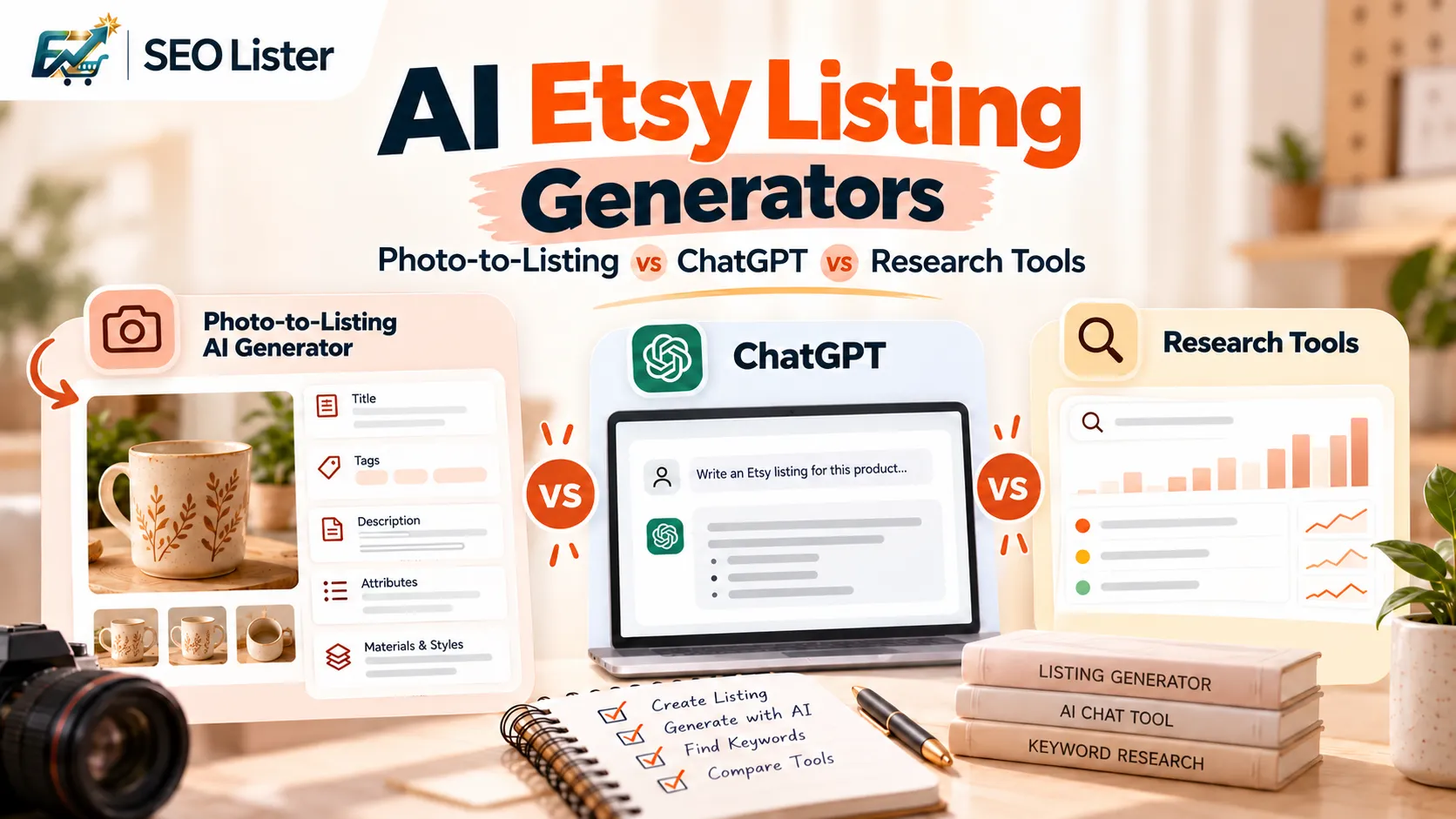
AI Etsy listing generators turn product inputs—often photos—into title, tag and description drafts shaped for Etsy's fields. ChatGPT can draft listing copy too, but purpose-built tools may add field-specific workflows, attributes, multilingual support, video creation or publishing. Research tools serve a different purpose: helping sellers investigate keywords, competitors and market opportunities.
The right choice depends on your inputs, the fields you need, your editing and publishing workflow, and how much human review the output requires. There is no single best tool for every Etsy seller.
Quick answer: Three AI and tool categories
Most tools sellers encounter fall into three categories: purpose-built listing generators, general AI chat tools and keyword research tools. Some products combine these functions, so evaluate what each one actually does rather than relying only on its marketing category.
| Category | Main purpose | When it makes sense |
|---|---|---|
| AI Etsy listing generators | Create structured listing drafts from product photos or written details | You want help creating titles, tags and descriptions |
| General AI chat tools | Draft, rewrite and adapt copy using prompts | You want flexibility and control over the writing process |
| Etsy research tools | Investigate keywords, competition and market opportunities | You need evidence to inform your listing decisions |
AI Etsy listing generators
These tools focus on producing content for product listings. Depending on the tool, the input might be a product photo, a written product brief, an existing listing or a combination of these.
Examples to investigate include ListifyAI, Insight Agent's Etsy AI Listing Generator and EtsyOptima.
Their workflows and feature sets may differ. Check each live product page to confirm supported inputs, generated fields, integrations, limits and current pricing.
General AI chat tools
ChatGPT and similar tools can help draft product titles, descriptions, tag ideas, personalization instructions and alternative versions of listing copy.
They offer flexibility, but you need to provide accurate product information and clear instructions. You may also need separate steps for keyword research, field completion and publishing.
Etsy keyword and research tools
Research tools help you investigate search phrases, competing listings and potential product opportunities. They can inform what you write, but research and generation are different tasks.
A keyword suggestion is not necessarily validated keyword data. Check whether a tool provides research evidence or simply generates phrases based on a prompt.
The practical distinction: generators create drafts, general AI tools provide flexible writing assistance, and research tools help you make better-informed decisions about what to write.
What a listing generator must output
A useful AI Etsy listing generator should fit the fields and tasks involved in preparing your listing. A tool that produces an appealing paragraph may not cover the rest of your workflow.
Titles that describe the product clearly
A title should identify the item and communicate its relevant characteristics. Keywords can help describe the product, but a title should remain understandable to shoppers.
For example, a handmade ceramic planter might need to communicate its product type, design and relevant style. The exact wording should reflect the actual item rather than a list of unrelated search phrases.
See our guide to writing Etsy titles that get found for more on creating clear, relevant titles.
Relevant tags
Tags help connect listings with shopper searches. A generator can suggest phrases, but you still need to check that each one describes the item accurately and adds useful context.
Etsy currently permits up to 13 tags per listing. Check the official Etsy Search guidance for current recommendations and requirements.
A generator should not be treated as proof that its suggested phrases have search demand. If keyword data matters to your decision, confirm whether the tool provides actual research data and what that data represents.
For practical tag guidance, see the Etsy tags guide.
Buyer-focused descriptions
Descriptions should answer questions that matter to buyers. Depending on the product, that can include materials, dimensions, intended use, care instructions, available variations and personalization details.
AI can help organize these details into readable copy. It should not invent missing specifications, safety claims, production methods or shipping promises.
Styles, materials and attributes
Some workflows also help populate product details beyond the title, tags and description. These fields must match the actual product and the options available in Etsy's listing form.
Check whether a tool generates these details directly, suggests values for you to review, or leaves them for manual completion.
Editing and publishing
Generation is only one part of listing creation. Look for ways to edit individual fields, regenerate sections, reuse templates and transfer or publish the reviewed content through a supported workflow.
A tool that creates a draft for manual copying can still be useful. The important question is whether the workflow fits the way you manage your shop.
For a full walkthrough of listing creation, see How to create a new Etsy listing.
Photo-to-listing vs text-only prompts
The input method determines how you provide product information. Neither method guarantees more accurate listings or better search performance.
How photo-to-listing generation works
A photo-to-listing workflow starts with product images. Depending on the tool, you may also provide a product name, measurements, materials, variations and other details.
The system uses the available information to draft listing fields. This can be convenient when you have product photography ready but have not written the listing copy.
However, an image does not reliably establish every product fact. A photo of a ceramic mug cannot confirm its exact capacity, whether it is dishwasher-safe or which materials were used.
Use photos as visual context, not as the sole source of truth.
How text-only generation works
A text-based workflow starts with a written product brief. You provide the product details, relevant keywords, intended audience and instructions for the fields you want to create.
This approach gives you direct control over the information supplied to the model. It can be particularly useful for complex variations, personalization rules or specifications that cannot be determined from photos.
The trade-off is that you must supply enough accurate information. Vague prompts can produce generic wording or unsupported assumptions.
Which method should you choose?
| Your situation | Practical starting point |
|---|---|
| You have product photos but no listing draft | Try a photo-to-listing generator |
| Your product has detailed specifications | Start with a written product brief |
| You already have a listing that needs rewriting | Use an AI editing workflow or chat tool |
| You need evidence about keyword opportunities | Start with a research tool |
| You manage many listings | Evaluate editing, templates and publishing as part of the whole workflow |
A hybrid workflow can work well: provide product photos, add verified specifications, generate the draft, review every field and publish only after checking the result.
Evaluation criteria checklist
Do not choose a tool based on the number of features in its marketing copy. Compare it against the work you actually need to complete.
For broader listing strategy, see the Complete Etsy SEO Guide.
1. Input flexibility
Can the tool use photos, written product details, existing listing content or a combination of inputs?
If your products have complex variations, confirm that you can supply the details explicitly instead of relying on the AI to infer them.
2. Field coverage
Check which fields the tool can create or assist with:
- Titles
- Tags
- Descriptions
- Materials and styles
- Relevant attributes and product details
- Personalization and variation information
Distinguish between fields the tool generates and fields it merely reminds you to complete.
3. Accuracy and constraints
Does the workflow help you respect Etsy's current field requirements? Can you edit the output easily? Does it make clear that product claims and specifications need verification?
No generator should be trusted to invent missing information.
4. Research evidence
Does the tool provide keyword research data, or does it generate keyword suggestions without showing supporting evidence?
These are different capabilities. If research matters, check the data source, date, scope and meaning before using the information to guide listing decisions.
5. Language support
If you sell to customers in multiple markets, check which languages the tool supports and whether the resulting copy can be reviewed and edited.
Translated listing content should preserve the meaning of the original, especially product specifications, customization instructions and care details.
6. Editing and publishing
Can you revise individual fields, regenerate selected sections, save templates and publish through a supported Etsy workflow?
Also check whether you can review the completed content before it goes live.
7. Video and other media
If you want to create listing videos from existing product photos, verify that the tool supports this workflow and that the resulting media meets Etsy's current requirements.
Do not assume that every listing generator includes video creation. You can also try SEOLister's Etsy listing video generator.
8. Cost and scale
Compare current prices, usage limits, included features and publishing restrictions on the providers' live websites.
A workflow suitable for a small catalog may differ from one designed for frequent listing creation. Evaluate the time required for generation, correction and publishing—not just the initial drafting step.
ChatGPT's place—and its limits
ChatGPT is useful when you want flexible writing assistance. You can ask it to draft a title, propose tag ideas, write a buyer-focused description, adjust the tone or create alternative versions.
The quality of the output depends on the quality of your instructions and product information.
Example: A structured Etsy listing prompt
Instead of asking, “Write an Etsy listing for my mug,” provide a clear brief:
Create a draft Etsy listing using only the verified details below.
Product: Handmade ceramic mug
Material: Stoneware ceramic, confirmed by the seller
Capacity: 350 ml, measured by the seller
Design: Hand-painted botanical pattern
Personalization: Not available
Care: Hand-wash recommended by the maker
Target buyer: Someone looking for a botanical-style giftDraft a clear title, relevant tag suggestions and a concise description. Do not invent production methods, safety certifications, shipping times or other product facts. Flag any missing information that must be confirmed before publishing.
This prompt provides useful context while setting boundaries around unsupported claims.
What ChatGPT does not automatically solve
A general chat tool may generate plausible-sounding keyword suggestions without validating their search demand. It may also require additional manual steps to complete every field and publish the listing.
Some of these gaps can be addressed with better prompts, external research and reusable instructions. However, that can create a more fragmented workflow than using a purpose-built listing tool.
Choose ChatGPT when flexibility is the priority. Choose a purpose-built generator when its structured workflow addresses work you repeatedly perform. You can also combine the two.
For a deeper ChatGPT comparison, see Can ChatGPT write Etsy listings?.
Research tools are not generators
Research and generation solve different problems. Research informs your decisions; generation turns product information and selected ideas into draft content.
Imagine that you sell personalized tote bags. You might research phrases related to custom tote bags, personalized gifts or relevant occasions. After reviewing that information, you can select phrases that accurately describe your item and use them in a listing draft.
The research does not write the complete listing by itself. The generator does not automatically validate every keyword it suggests.
A practical combined workflow
- Research: Investigate relevant search phrases, competing listings and market opportunities.
- Select: Choose phrases that accurately describe your product and fit your intended audience.
- Generate: Create the title, tags and description using verified product details.
- Review: Check the wording, product facts, attributes and current Etsy requirements.
- Publish: Inspect the completed Etsy listing before making it available to shoppers.
For a wider comparison of research and optimization options, read Best Etsy SEO Tools. That article is the better starting point for readers who want a broader tool shortlist.
Human QA checklist after any AI draft
AI-generated copy is a starting point. Sellers remain responsible for ensuring that their listings are accurate and comply with current marketplace requirements.
Before publishing, check the following:
- Verify product facts. Confirm materials, dimensions, capacity, production details and other factual claims against reliable product information.
- Review the title. Make sure it identifies the item clearly and uses relevant phrases naturally.
- Check every tag. Remove irrelevant, misleading or repetitive suggestions and confirm current Etsy limits.
- Verify attributes. Ensure styles, materials, colors, categories and other details match the product.
- Review personalization. Explain what buyers can customize, what information they must provide and any applicable restrictions.
- Confirm shipping and processing details. Use your actual shop policies and settings. Never allow AI to invent delivery promises.
- Read the description as a buyer. Check that it answers likely questions without unsupported claims or unnecessary keyword repetition.
- Check translations. Ensure translated content preserves the original product details and meaning.
- Inspect the Etsy form. Confirm the information appears in the correct fields and required details are complete.
- Review before publishing. Recheck the current Etsy guidance and inspect the final listing.
This process matters whether your draft came from ChatGPT, a photo-based generator or another AI writing tool.
Where SEOLister sits: The execution layer
SEOLister is designed to help sellers move from product images and details to structured Etsy listing content.
Its features include photo-based generation of titles, tags, descriptions, styles and materials; a listing completion score; multilingual support in English, French, German, Dutch and Russian; listing video creation from photos; reusable templates; and a workflow for publishing to Etsy.
The completion score is a SEOLister tool metric for reviewing listing completeness. It is not Etsy's Search Visibility score, an Etsy ranking metric or a prediction of sales.
SEOLister fits the execution layer: it helps prepare and manage listing content. Sellers should still verify product facts, evaluate keyword relevance and review the completed listing before publishing.
Explore SEOLister's features, review the SEOLister vs ListifyAI comparison, or check current pricing to see whether its workflow fits your shop.
You can also browse the Etsy selling guide for broader seller setup help.
Choose the workflow that fits your shop
The useful question is not simply which AI tool is the best. It is whether you need flexible writing, photo-to-listing generation, keyword research or a combination of these tasks.
Start with the part of listing creation that takes the most effort in your current workflow. Compare inputs, field coverage, editing controls, research evidence and publishing options. Then review the output carefully before it reaches your Etsy shop.
Explore SEOLister features to see how its listing-generation workflow fits your process.
Explore SEOLister's free tools for individual listing-related tasks.
Frequently Asked Questions
What is an AI Etsy listing generator?
An AI Etsy listing generator creates draft listing content from product photos, written information or other supported inputs. Depending on the tool, it may produce titles, tags, descriptions, styles and materials. Sellers should verify the generated details before publishing.
Is ChatGPT good for writing Etsy listings?
ChatGPT can help draft and revise Etsy titles, descriptions and tag ideas when given accurate product information and clear instructions. It offers flexible writing control, but sellers may need separate steps for keyword research, field completion and publishing.
What is the difference between an AI listing generator and an Etsy SEO tool?
A listing generator focuses on producing listing content. An Etsy SEO or keyword research tool focuses on investigating search terms, competition or optimization opportunities. Some products combine these functions, so check their current features rather than relying only on their category labels.
Is photo-to-Etsy-listing generation better than text prompts?
Neither method is universally better. Photos provide visual context, while written briefs can communicate specifications that are difficult to infer from images. Combining photos with verified product information can provide a useful starting point for a listing draft.
What should I check before publishing an AI-generated Etsy listing?
Verify materials, dimensions, product claims, tags, attributes, personalization rules, shipping details and translations. Check Etsy's current requirements and review the completed listing in the actual Etsy form before publishing.
Does an AI listing generator guarantee better Etsy rankings or more sales?
No. Generating listing copy does not guarantee search placement, traffic or sales. Evaluate tools based on their workflow, accuracy and usefulness rather than promises of results.
Can I use an AI generator and keyword research tools together?
Yes. Research tools can help you investigate relevant phrases, while a listing generator can turn selected phrases and verified product information into draft content. Review the output to ensure that it describes the actual product accurately and naturally.

Etsy SEO Tools
Best Etsy SEO Tools in 2026: Research vs Listing Optimization
Compare the best Etsy SEO tools by workflow—keyword research, listing optimization, titles, tags, and publishing—so you pick the right stack for your shop.
Etsy SEO Tools
Best Etsy Listing Optimizer Tools in 2026
Etsy sellers do not all need the same software. Compare listing optimizers for AI writing, keyword research, audits, and publishing, and see where SEOLister fits.
Etsy SEO
Can ChatGPT Write Etsy Listings? What Sellers Should Know
ChatGPT can draft Etsy titles, tags, and descriptions. A dedicated listing workflow still has to create, check, and publish those listings in your shop.