
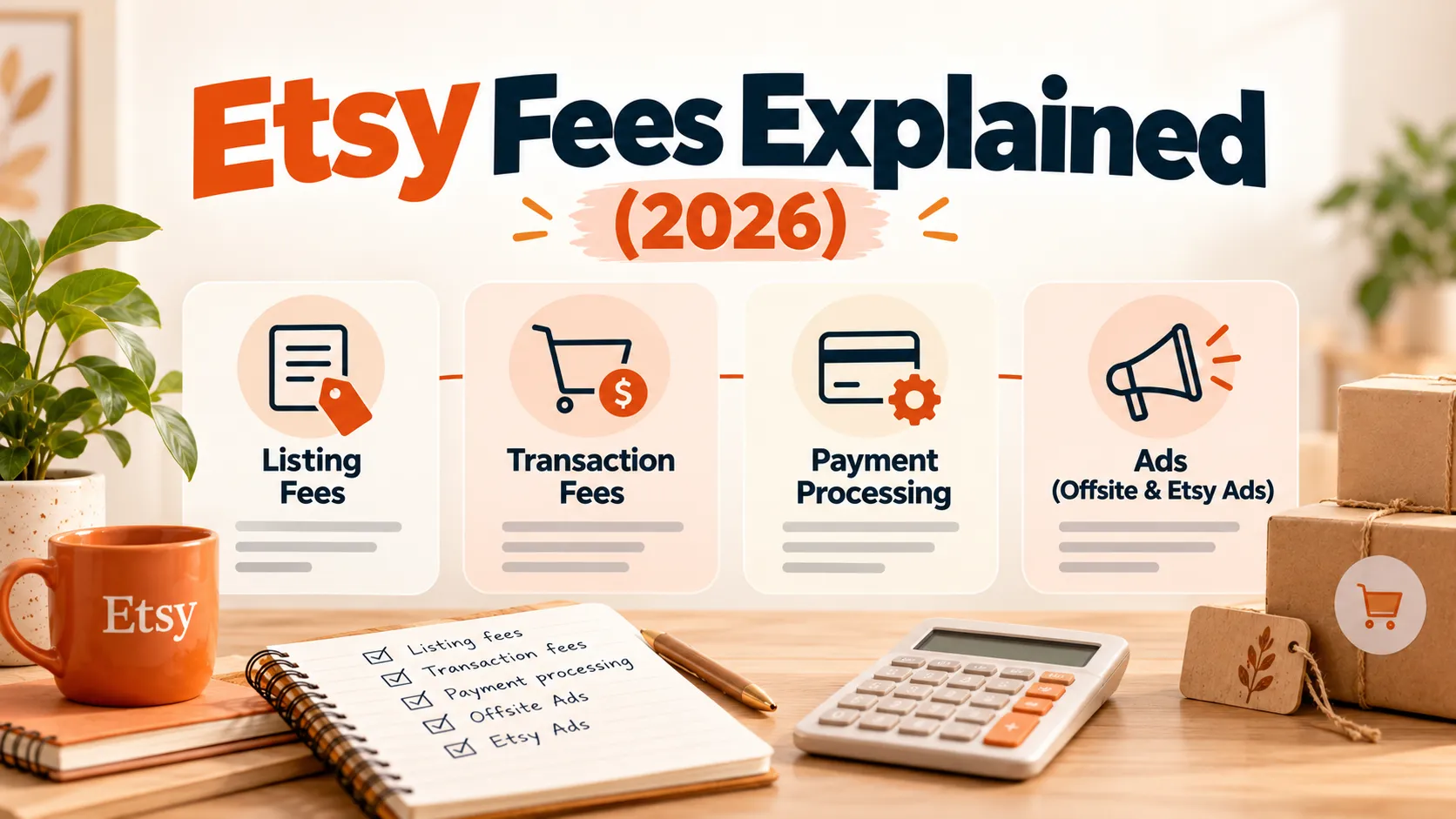
Etsy charges a mix of listing, transaction, payment processing and optional advertising fees. Your total cost depends on your seller location, order value, shipping charges, advertising attribution and other applicable charges.
Fee information checked: October 29, 2026. Rates below are based on Etsy's official policies available on this date. Always verify the live policy for your country before setting prices.
The official source of truth is Etsy's Fees & Payments Policy. This guide explains the fee types in plain language so you can estimate costs before pricing handmade products or scaling a print-on-demand (POD) catalog.
Quick answer: Etsy fee types at a glance
Etsy does not charge every seller the same total percentage on every order. Some fees apply when you publish a listing, others apply when you make a sale, and advertising fees depend on how the sale was attributed.
| Fee type | What triggers it | What to know |
|---|---|---|
| Shop setup fee | Opening a shop, when Etsy requires one | A one-time fee may be displayed during onboarding |
| Listing fee | Creating or renewing a listing | Etsy's policy lists $0.20 USD per listing |
| Transaction fee | Making a sale | 6.5% of the listing price plus shipping and gift wrapping |
| Payment processing | Processing an order through Etsy Payments | Varies by the location of your bank account |
| Offsite Ads | A qualifying sale attributed to Etsy's external advertising | The applicable rate is 12% or 15% |
| Etsy Ads | Running paid ads within Etsy | Costs depend on your advertising budget and clicks |
| Other applicable charges | Depending on location and payment setup | May include regulatory fees, currency conversion, taxes or deposit-related charges |
Sources: Etsy Fees & Payments Policy and Etsy Payments Policy. Etsy's Fees & Payments Policy showed a last-updated date of October 5, 2026 when checked.
The important distinction is that the listing fee is not your total selling cost. To estimate profit, you must account for the fees that apply to the specific order, along with product costs, fulfillment, shipping and advertising.
Listing fees
Etsy charges a listing fee when you create or renew a listing. The current official policy lists the fee as $0.20 USD per listing. This charge applies whether or not the item sells. Editing an existing listing does not incur an additional listing fee by itself.
Etsy listings generally expire after four months. If automatic renewal is enabled, Etsy can charge the listing fee again when the listing renews. When you list multiple quantities, the initial listing fee is charged when you create the listing, and a renewal fee applies as each additional quantity sells. Review the official listing fee policy for the full conditions.
Why listing fees matter when you scale
Suppose you publish many products before validating demand. You may pay listing fees even if some products never sell.
For a POD shop, this means the cost of creating and maintaining a large catalog belongs in your planning. The fee for an individual listing is small, but repeated publishing and renewal charges can accumulate.
Before adding more products, consider whether each listing has accurate product details, suitable photos, a clear price and a realistic chance of meeting your business goals.
For the publishing steps themselves, see Etsy's How to Create a Listing guide and our walkthrough on creating a new Etsy listing.
Transaction fees
Etsy's current policy sets the transaction fee at 6.5% of the displayed listing price plus the amount charged for shipping and gift wrapping. The policy also explains how taxes and additional personalization charges are treated in different jurisdictions. Check Etsy's current policy before calculating your exact fee.
What does the transaction fee apply to?
The transaction fee is not necessarily calculated on the product price alone.
For example, if you sell a product and charge separately for shipping, Etsy includes the shipping amount in the transaction fee calculation. If the buyer pays for gift wrapping, that charge is also included.
This matters when comparing a listing with separately charged shipping against one where shipping is included in the product price. Your price structure can change the amounts involved, but it does not eliminate the transaction fee.
A simple transaction fee example
Imagine a hypothetical order with:
- Product price: $30
- Shipping charged to the buyer: $5
- Gift wrapping: $0
The amount used for this simplified transaction fee example is $35.
At the official 6.5% rate:
$35 × 0.065 = $2.275
The transaction fee would be approximately $2.28, before considering other Etsy fees, applicable taxes or currency-related charges.
This is only one part of the total cost. Payment processing and any applicable listing or advertising fees must be considered separately.
Payment processing fees
Payment processing fees cover the processing of payments through Etsy Payments. Unlike the transaction fee, the rate depends on the location of the seller's bank account.
Etsy's official Etsy Payments Policy provides a country-by-country fee table.
As checked on October 29, 2026, the published payment processing rates included:
| Seller bank account location | Payment processing fee |
|---|---|
| India | 5% + ₹25 per order |
| United States | 3% + $0.25 per order |
| United Kingdom | 4% + £0.20 per order |
These figures are from Etsy's official policy, not estimates from a third-party calculator. Check the live policy for your location before relying on them.
What is the payment processing fee calculated on?
Etsy states that payment processing fees are assessed on the gross order amount, including shipping and applicable taxes.
The fee typically combines a percentage of the order amount with a fixed charge. This means the total is not simply a flat percentage of your product price.
For example, an India-based seller should not use the US processing rate when calculating margins. The seller's payment account location determines which rate applies.
Other payment-related costs
Depending on your location and account setup, additional charges may apply. These can include deposit fees in certain markets, applicable taxes on fees, currency conversion, and charges imposed by a third-party payment provider.
For example, Etsy's policy states that sellers in India use Etsy Payments through Payoneer. Payoneer may have separate withdrawal fees and requirements, so check its current terms as well as Etsy's policy.
Offsite Ads and Etsy Ads
Etsy offers two advertising options that affect costs differently: Offsite Ads and Etsy Ads.
Offsite Ads fees
Offsite Ads promote Etsy listings on external platforms. A fee applies when a buyer clicks an eligible offsite advertisement and places an order that meets Etsy's attribution rules.
Etsy's policy currently specifies these rates for attributed orders:
- 15% when the shop is below the relevant $10,000 USD sales threshold over the preceding 365 days, unless the seller opts out while eligible.
- 12% after the shop reaches the threshold, when the policy's participation requirements apply.
The fee applies to qualifying orders, not automatically to every order in your shop. Etsy also describes a 30-day attribution window and additional rules in its Fees & Payments Policy.
Check the current policy to understand eligibility, opt-out rules and what happens when a shop reaches the threshold.
Etsy Ads fees
Etsy Ads promote listings within Etsy. Sellers choose a daily maximum advertising budget, and the cost depends on their advertising activity.
Unlike Offsite Ads, which charge a fee on qualifying attributed orders, Etsy Ads are budget-based advertising. Advertising spend needs to be considered alongside the revenue and profit associated with the orders it generates.
For example, a product can sell and still have a weak margin if its production cost, marketplace fees and advertising spend leave little money remaining.
Why advertising costs belong in your pricing model
Do not assume that every order will incur an Offsite Ads fee, or that no order will incur one. Model the scenarios that are relevant to your shop.
A useful pricing worksheet can include:
- A normal sale without advertising attribution.
- A sale attributed to Offsite Ads.
- A sale supported by paid Etsy Ads, with the relevant ad spend allocated to the order.
This makes it easier to see whether a product remains viable under different selling conditions.
How Etsy fees affect pricing and profit margins
Your selling price should cover more than the cost of making a product. It must also leave room for marketplace fees, fulfillment, packaging, advertising and other business expenses.
A simple margin worksheet is:
Product price + shipping collected − Etsy fees − product cost − fulfillment − packaging − advertising = estimated profit
The calculation needs to reflect your actual costs and applicable fee rules.
Step 1: Calculate product and fulfillment costs
For handmade products, include materials, labor, packaging and any outsourced work.
For POD products, include the production charge, shipping charged by your provider, additional product options and any other fulfillment costs that you pay.
Do not treat the amount left after Etsy fees as profit until these costs have been deducted.
Step 2: Estimate marketplace fees
Include the listing fee where applicable, transaction fee, country-specific payment processing fee and any other relevant charges.
If your listing and payment account currencies differ, check Etsy's currency conversion rules. The policy currently describes a 2.5% currency conversion fee when a seller lists and sells in a currency different from their payment account currency and the service is required.
Step 3: Model advertising scenarios
Estimate how much advertising spend may be associated with an order. For Offsite Ads, consider the applicable fee if the order qualifies. For Etsy Ads, use your actual campaign spend and a reasonable method for allocating it across orders.
Do not assume every order will have the same fee profile.
Step 4: Add a margin buffer
Leave room for discounts, refunds, replacement products, changes in supplier costs and other expenses relevant to your business.
The goal is not simply to cover the fees on one sale. It is to choose prices that remain workable across your expected order mix.
A reusable margin worksheet
| Cost component | Your value |
|---|---|
| Product price | Enter amount |
| Shipping collected | Enter amount |
| Product or POD production cost | Enter amount |
| Packaging and fulfillment | Enter amount |
| Etsy listing fee | Enter applicable amount |
| Transaction fee | Calculate from current policy |
| Payment processing fee | Use your country-specific rate |
| Offsite Ads fee, if applicable | Calculate for attributed orders |
| Etsy Ads allocation, if applicable | Enter estimated cost |
| Other applicable charges | Enter amount |
| Estimated profit | Calculate remaining amount |
This worksheet is a planning framework, not a substitute for Etsy's live fee calculation or your actual payment account statement.
Use a fee calculator before publishing more listings
Manual calculations are useful for understanding the fee structure, but they become repetitive when you need to evaluate multiple products and price points.
SEOLister's free tools hub includes an Etsy fee calculator. Use the tool to estimate fees, then confirm the inputs and applicable charges against Etsy's current policies.
A calculator is most useful when you enter realistic prices and costs. It cannot produce a reliable profit estimate if you leave out shipping, production expenses, advertising or country-specific fees.
Before scaling a product catalog, estimate the margin first and verify the result against your actual seller account.
How SEOLister fits into listing preparation
Fees affect the economics of a product, while listing preparation affects how clearly that product is presented to potential buyers. These are different parts of running an Etsy shop.
SEOLister helps sellers prepare listing content from product photos and details, including titles, tags, descriptions, styles and materials. Its tools also include a completion score, multilingual listing support, listing video creation from photos and a workflow for publishing to Etsy.
These features can support the listing preparation process, but they do not calculate your full business profitability or guarantee search placement or sales.
Review your fee assumptions and product margins before expanding a catalog. Then use an appropriate listing workflow to prepare accurate, complete product information.
For related listing preparation help, see How to write Etsy titles that get found, the Etsy tags guide, and the Complete Etsy SEO Guide. New sellers can also start with Etsy SEO for a new shop.
Explore SEOLister's features, pricing, or read the Etsy Selling Guide for more seller guidance.
Price with the full cost in mind
Etsy fees are easier to manage when you separate listing costs, transaction charges, payment processing and advertising. The correct total depends on your location and the details of each order, so avoid using a single percentage as a universal estimate.
Check the official policy, calculate your actual product and fulfillment costs, and model both ordinary and advertising-attributed sales before scaling your catalog.
Open SEOLister's free tools and use the Etsy fee calculator to estimate your selling costs.
Read the Etsy Selling Guide for more guidance on listing preparation, pricing awareness and shop growth.
Frequently Asked Questions
How much does Etsy take from a sale in 2026?
Etsy charges a 6.5% transaction fee on the displayed listing price plus shipping and gift wrapping, along with payment processing fees that depend on the seller's bank account location. Listing fees, advertising charges, taxes and other applicable costs can increase the total. Check Etsy's live policy to calculate the amount for your specific order.
What is the Etsy listing fee in 2026?
Etsy's official Fees & Payments Policy lists a $0.20 USD listing fee for each item listed on Etsy. The fee can apply when a listing is created or renewed, even if the item does not sell. Additional renewal fees may apply when listings renew or multiple quantities sell.
Are Etsy transaction fees and payment processing fees the same?
No. The transaction fee is a percentage of the listing price plus applicable shipping and gift wrapping charges. Payment processing is a separate charge for processing the order through Etsy Payments, and its rate varies by the seller's bank account location.
Does Etsy charge fees if my item does not sell?
Yes. A listing fee can apply when you publish a listing even if it never sells. Transaction and payment processing fees are generally associated with sales, while advertising and other charges depend on the services or circumstances involved.
Are Etsy Offsite Ads fees charged on every sale?
No. Offsite Ads fees apply to orders attributed to eligible offsite advertising under Etsy's rules. The applicable rate depends on the shop's sales threshold and participation requirements, so review Etsy's current policy before estimating the cost.
How do I calculate Etsy fees for a POD product?
Start with your selling price and shipping, then calculate applicable Etsy fees using your seller location and order details. Subtract production, fulfillment, packaging and advertising costs to estimate profit. Use a fee calculator for an initial estimate, but verify the results against the current official policy.
Can I avoid Etsy fees by offering free shipping?
No. Transaction fees can apply to the displayed listing price, and the way shipping is presented does not eliminate the fee. If you include shipping costs in your product price, account for those costs when calculating the margin.

Etsy SEO
How to Create an Etsy Listing with SEOLister in 2026
Spending an hour per listing on titles and tags? Use an SEO-first create flow so new products go live complete—and searchable—the first time.

Etsy SEO
Etsy SEO for New Shops: How to Get Your First Organic Traffic
Opened your shop and got silence? Fix empty titles, random tags, and incomplete listings so first products can earn organic Etsy search traffic.

Etsy SEO
The Complete Etsy SEO Guide 2026
Rankings stalling across the shop? Follow this map for keywords, titles, tags, attributes, and photos so every listing has a path to get found.