
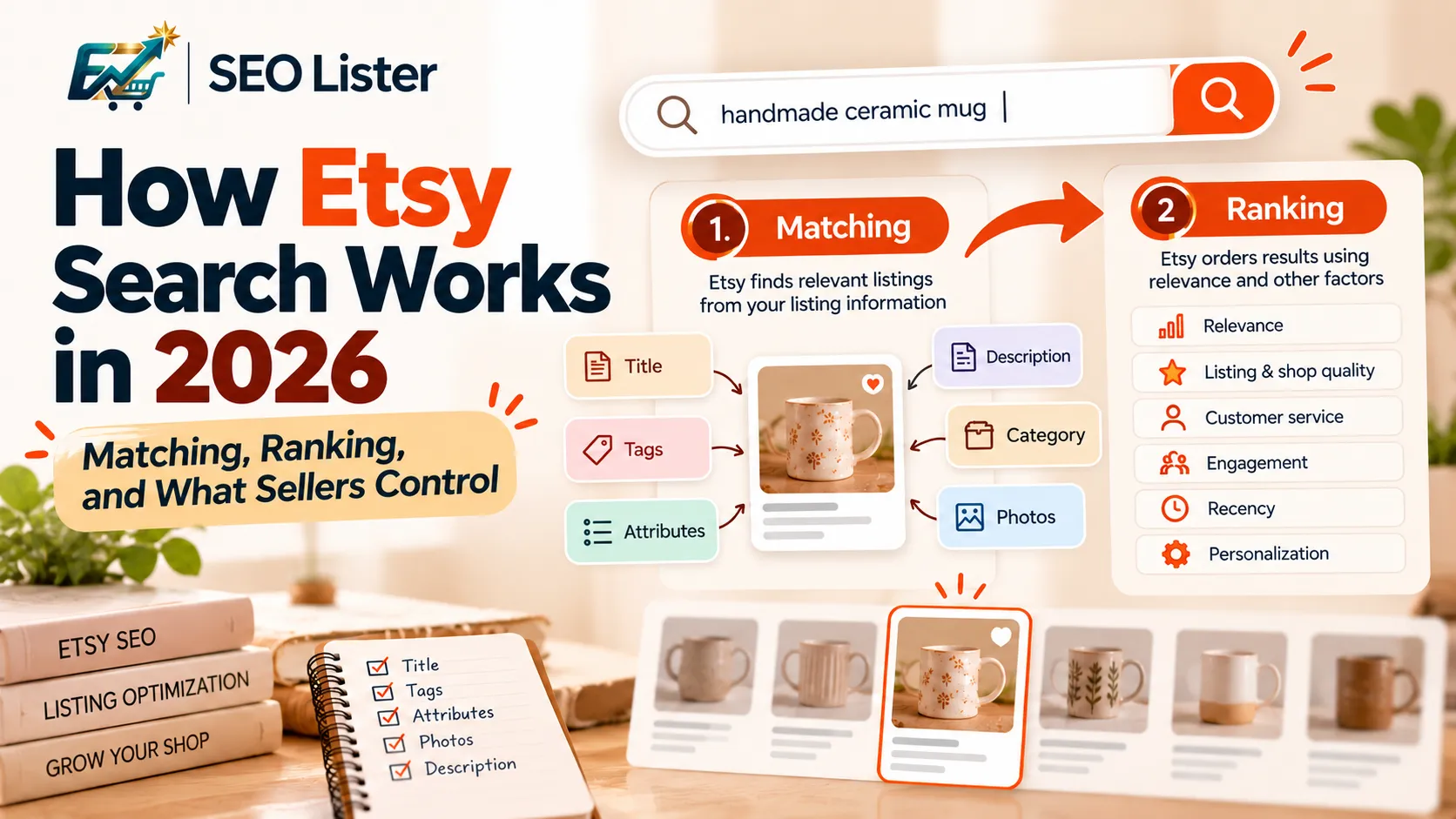
Etsy search works in two broad stages: query matching and ranking. First, Etsy identifies listings that are relevant to a shopper's search. Then, it orders matching results using factors that include relevance, listing and shop quality, customer service, engagement, and personalization.
Sellers cannot control every part of this process. They can, however, improve how clearly their listings describe their products, use relevant titles and tags, complete attributes, present accurate photos, and maintain a good customer experience. Understanding these mechanics is more useful than trying to guess a secret algorithm score.
Etsy can update its systems and guidance, so always check its official How Etsy Search Works resource for the latest information.
Quick Answer: Matching Then Ranking
Etsy search is not simply a system that counts keywords in a title.
Query matching determines which listings are relevant to the shopper's search. Etsy uses listing information such as titles, tags, attributes, descriptions, categories, and other relevant signals to understand what a product is and whether it matches the query.
Ranking determines the order of matching results. Etsy considers multiple factors, including relevance, listing quality, shop quality, customer service, engagement, and shopper-specific context.
This distinction matters. A listing must first be relevant to a search, but matching a query does not guarantee a particular position.
For example, a shopper searching for a personalized ceramic mug should be able to find listings that accurately describe personalized ceramic mugs. A listing with a vague title and incomplete product details may provide weaker matching information than one that clearly identifies the product, its material, and its personalization options.
The objective is to make the listing accurate, relevant, and useful—not to manipulate an assumed ranking formula.
What Etsy Says Publicly About Search
Etsy publishes information about search through its Seller Handbook, Help Center, and engineering articles. These resources explain the broad principles behind search without exposing a complete, fixed formula for every query.
Etsy uses multiple listing signals
Etsy's How Etsy Search Works guide explains that search considers more than titles alone. Listing relevance, quality, customer service, engagement, and personalization all play roles in how results are presented.
That means optimizing a listing is not just a matter of repeating the same phrase in several places. Product details need to work together so shoppers and Etsy can understand what is being offered.
Etsy is developing semantic search relevance
In its engineering article, How Etsy Uses LLMs to Improve Search Relevance, Etsy describes how large language models can help assess the relationship between a shopper's query and a listing.
Semantic relevance is important because shoppers do not always use the exact words sellers choose. Someone might search for a gift for a new homeowner, while a seller describes an item as a personalized housewarming present.
Understanding meaning can help a search system recognize that relationship even when the wording differs.
This does not mean sellers should abandon keywords. Clear, relevant listing information still matters. It means sellers should describe their products naturally and accurately instead of relying on exact-match repetition alone.
Query Matching: Which Listing Fields Can Sellers Control?
The first practical task is to help Etsy understand what the product is and which searches it may satisfy.
1. Titles
Your title should identify the product clearly and include its most important characteristics.
Etsy's April 2026 title guidance emphasizes clear, readable titles. It recommends naming the item, highlighting important objective traits, and avoiding unnecessary repetition.
For example:
Less clear: Beautiful Perfect Gift for Her Custom Necklace Personalized Necklace
Clearer: Personalized Birthstone Necklace, Custom Silver Pendant
The revised example is only appropriate if the item genuinely is a personalized birthstone necklace with a silver pendant.
A title should help shoppers understand the product quickly. It does not need to contain every possible keyword or every detail that belongs in the description.
For more guidance, read How to Write Etsy Titles That Get Found.
2. Tags
Tags help Etsy understand the different search phrases that may be relevant to your product.
Use them to describe the item, its intended use, materials, style, recipient, or occasion when those details genuinely apply.
For example, a seller offering personalized housewarming gifts might consider phrases related to personalized gifts, new-home gifts, or housewarming presents, depending on the actual product.
Avoid using unrelated tags just because they appear popular or seem broadly relevant. A tag should accurately describe the listing and reflect a plausible way shoppers might search for it.
Read the Etsy Tags Guide for a practical approach to tag selection.
3. Categories and attributes
Categories and attributes provide structured information about a product.
Choose the most accurate category available and complete relevant attributes, such as color, material, size, or style. Available options depend on the category and product type.
Do not select an attribute simply to capture an additional keyword. Incorrect information can mislead buyers and create inconsistencies between your listing fields.
For more detail, see Etsy attributes.
4. Descriptions
Descriptions help shoppers understand the product in more detail. They can explain dimensions, materials, personalization options, what's included, care instructions, and other important facts.
Write naturally and answer likely buyer questions. Avoid copying a block of keywords into the description or repeating the title without adding useful information.
Keep the description consistent with the title, photos, attributes, and actual product.
5. Photos and other listing details
Photos help shoppers evaluate what they are considering purchasing. Your first image should clearly represent the product, while additional images can show details, scale, variations, or how the item is used.
Other listing information, including reviews and the overall buyer experience, can also contribute to how Etsy evaluates and presents listings.
Use Etsy's SEO guidance for shop and listing pages alongside the Seller Handbook when reviewing your listing setup.
Ranking Factors: What Sellers Can Influence and What They Cannot
After matching, Etsy determines how matching results should be ordered. Sellers can influence some factors, but they cannot control the entire search system.
| Factor | What it means for sellers |
|---|---|
| Relevance | Use accurate titles, tags, categories, attributes, and descriptions. |
| Listing quality | Present the product clearly and provide the information shoppers need. |
| Shop quality | Maintain a professional, trustworthy shop experience. |
| Customer service | Pay attention to reviews, communication, and case handling. |
| Engagement | Make listings useful and appealing to the shoppers they are intended for. |
| Recency | Understand that new or renewed listings may receive a temporary boost, rather than treating repeated renewals as a long-term strategy. |
| Personalization | Recognize that different shoppers may see different results based on their context and habits. |
These factors do not operate as a simple checklist where completing every item guarantees a particular position. Etsy controls its ranking systems and how it weighs different signals.
Customer service and shop quality matter
Search optimization should not stop at keywords. A useful listing must also be supported by a good buying experience.
Accurate product descriptions, responsive communication, reliable order handling, and clear shop policies help shoppers make informed decisions.
Etsy's published guidance discusses customer service signals, including average review rating, message response rate, and case rate over the preceding three months. Sellers should consult the current official guidance for the applicable definitions and requirements.
Engagement is not a shortcut
A listing that attracts and satisfies shoppers may provide useful engagement signals, but there is no guaranteed way to manufacture engagement and secure a particular ranking.
Focus on the parts you can improve: product presentation, clarity, accurate information, and a listing that matches the expectations created by its photos and title.
Personalization means rankings can differ
Two shoppers searching for the same phrase may not see identical results. Etsy explains that shopper-specific context can influence results.
As a result, a single search from your own account is not a reliable measure of how every buyer sees your listing. Use your shop's available data and Etsy's official guidance rather than relying on one search result position.
Listing Quality and Etsy Search Visibility
Etsy's Search Visibility page helps sellers identify certain issues that may affect their shop or listings. It is useful as a diagnostic resource, but it is not a complete explanation of every ranking decision.
Use it alongside your own listing review.
Check that your listing:
- Clearly identifies the product.
- Uses relevant titles and tags.
- Has an accurate category and applicable attributes.
- Includes clear, representative photos.
- Provides complete and truthful product details.
- Offers a consistent buyer experience.
Do not confuse a completeness checklist with Etsy's own search systems. Completing missing fields is useful, but it does not guarantee a ranking improvement.
Etsy SEO Myths to Drop
Myth 1: Keyword stuffing improves ranking
Repeating the same phrase across a title and description does not automatically make a listing more relevant. Use accurate, readable wording and cover different relevant search phrases naturally.
Myth 2: There is a secret SEO score that determines everything
Etsy search uses multiple signals. No single score available to sellers fully explains every search result or guarantees a position.
Myth 3: Etsy Ads automatically boost organic rankings
Etsy states that advertising does not improve organic search placement outside designated ad placements. Treat paid advertising and organic search as distinct channels.
Myth 4: Star Seller guarantees higher organic placement
Etsy has stated that Star Seller does not directly affect search ranking. Customer service still matters, but earning the badge is not a substitute for relevant listings and a good buyer experience.
Myth 5: Renewing listings repeatedly is a reliable ranking hack
Etsy describes the boost associated with new or renewed listings as temporary. Repeated renewals solely to chase that boost are not a substitute for improving listing relevance and quality.
Always recheck Etsy's current search guidance, since platform rules and explanations can change.
A Practical Etsy Search Checklist
Use this checklist when publishing a new listing or reviewing an existing one.
Query matching
- The title clearly identifies the product.
- Important characteristics are included where relevant.
- Tags describe realistic searches for the item.
- The category accurately represents the product.
- Applicable attributes are completed correctly.
- The description answers common buyer questions.
- Photos clearly represent the item.
Listing and shop quality
- Product details are accurate and consistent.
- Variations, personalization, and materials are explained.
- Shipping and processing information is current.
- Shop policies and customer communication are maintained.
- Reviews and buyer feedback are monitored.
- Etsy's Search Visibility page has been reviewed where available.
Measurement and maintenance
- Changes are documented before editing established listings.
- Shop statistics are reviewed over a suitable period.
- Performance changes are evaluated without assuming a single cause.
- Etsy's official guidance is checked for recent updates.
This process gives you a repeatable way to maintain listings without relying on unverified ranking tricks.
How SEOLister Supports Etsy Search Preparation
SEOLister helps sellers prepare the listing fields that describe their products. You can use product photos to generate titles, tags, descriptions, styles, and materials, then review and edit the information before publishing.
The workflow is designed to help sellers organize listing information and identify incomplete fields. Its completion score is a field-completeness checklist, not Etsy's Search Visibility score or a measurement of search ranking.
SEOLister can help with the listing preparation process, but it does not control Etsy's ranking models or guarantee search placement.
Explore SEOLister's features to see how its listing workflow fits into your shop.
Final Thoughts: Optimize What You Can Control
Understanding how Etsy search works helps you spend time on improvements that are within your control.
Make products easy to identify through clear titles, relevant tags, accurate categories and attributes, useful descriptions, and representative photos. Maintain your shop's buyer experience, use available diagnostics, and evaluate your own shop data over time.
Avoid treating ranking as a fixed formula or chasing shortcuts that promise guaranteed results. Etsy's search systems evolve, so use its official guidance as your reference point.
Explore SEOLister to prepare, review, and publish clearer Etsy listings.
Read the Complete Etsy SEO Guide for a broader strategy covering listing optimization.
Sources and Further Reading
Frequently Asked Questions
How does Etsy search work in 2026?
Etsy search broadly involves matching listings to a shopper's query and then ranking matching results. Matching uses listing information and relevant signals, while ranking considers multiple factors such as relevance, quality, customer service, engagement, and personalization.
What are the main Etsy search ranking factors?
Etsy's published guidance identifies relevance, listing quality, shop quality, customer service, engagement, recency, and personalization among the factors involved in search. Their exact influence can vary, and Etsy does not publish a single formula that guarantees a particular position.
Do Etsy titles matter more than tags?
Titles and tags both help Etsy understand a listing's relevance. Sellers should use clear titles and relevant tags together, supported by accurate categories, attributes, descriptions, and photos rather than relying on a single field.
Does Etsy use AI in search?
Etsy Engineering has described using large language models to improve search relevance by evaluating the relationship between queries and listings. This supports semantic understanding, but it does not mean sellers should abandon relevant keywords or that a particular AI optimization guarantees higher rankings.
Do Etsy Ads improve organic search rankings?
Etsy states that ads do not affect organic search placement outside designated advertising spaces. Advertising can provide a separate way to reach shoppers, but sellers should not treat it as a direct organic ranking boost.
Does SEOLister's completion score affect Etsy ranking?
No. SEOLister's completion score is intended to help sellers review listing-field completeness. It is not Etsy's Search Visibility score, does not measure ranking, and does not guarantee a search placement.
Why do different shoppers see different Etsy search results?
Etsy personalizes results using shopper-specific context and habits. This means search results can differ between shoppers, so checking one search position does not establish how every potential buyer sees a listing.

Etsy SEO
The Complete Etsy SEO Guide 2026
Rankings stalling across the shop? Follow this map for keywords, titles, tags, attributes, and photos so every listing has a path to get found.

Etsy SEO
How to Write Etsy Titles That Get Found in 2026
Titles that sound clever but never rank? Learn keyword placement shoppers actually type so your listings show up before competitors do.
Etsy SEO
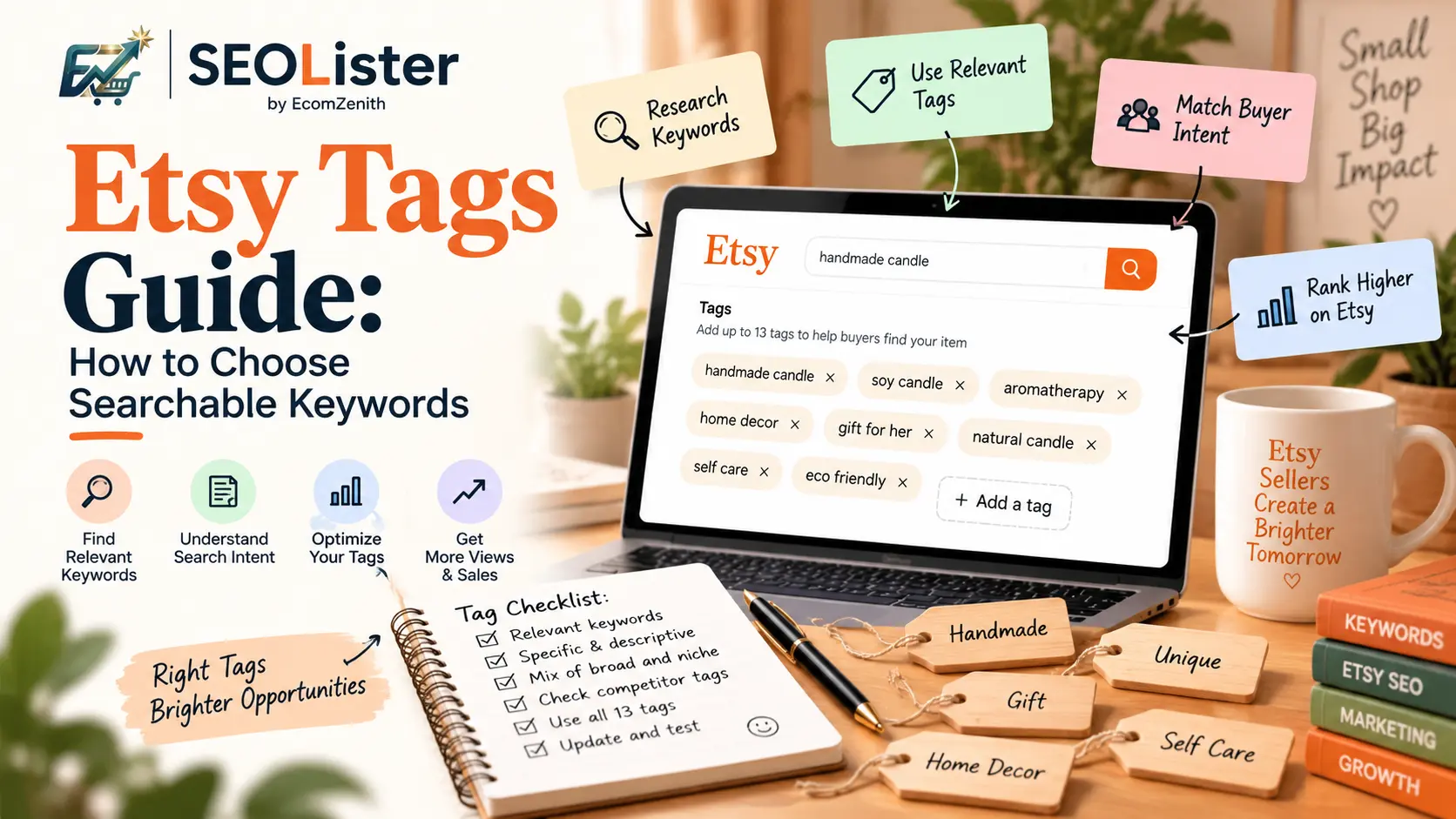
Etsy Tags Guide: How to Choose Searchable Keywords
Learn how to choose all 13 Etsy tags using specific, buyer-focused search phrases that can help your listings match relevant Etsy searches.