
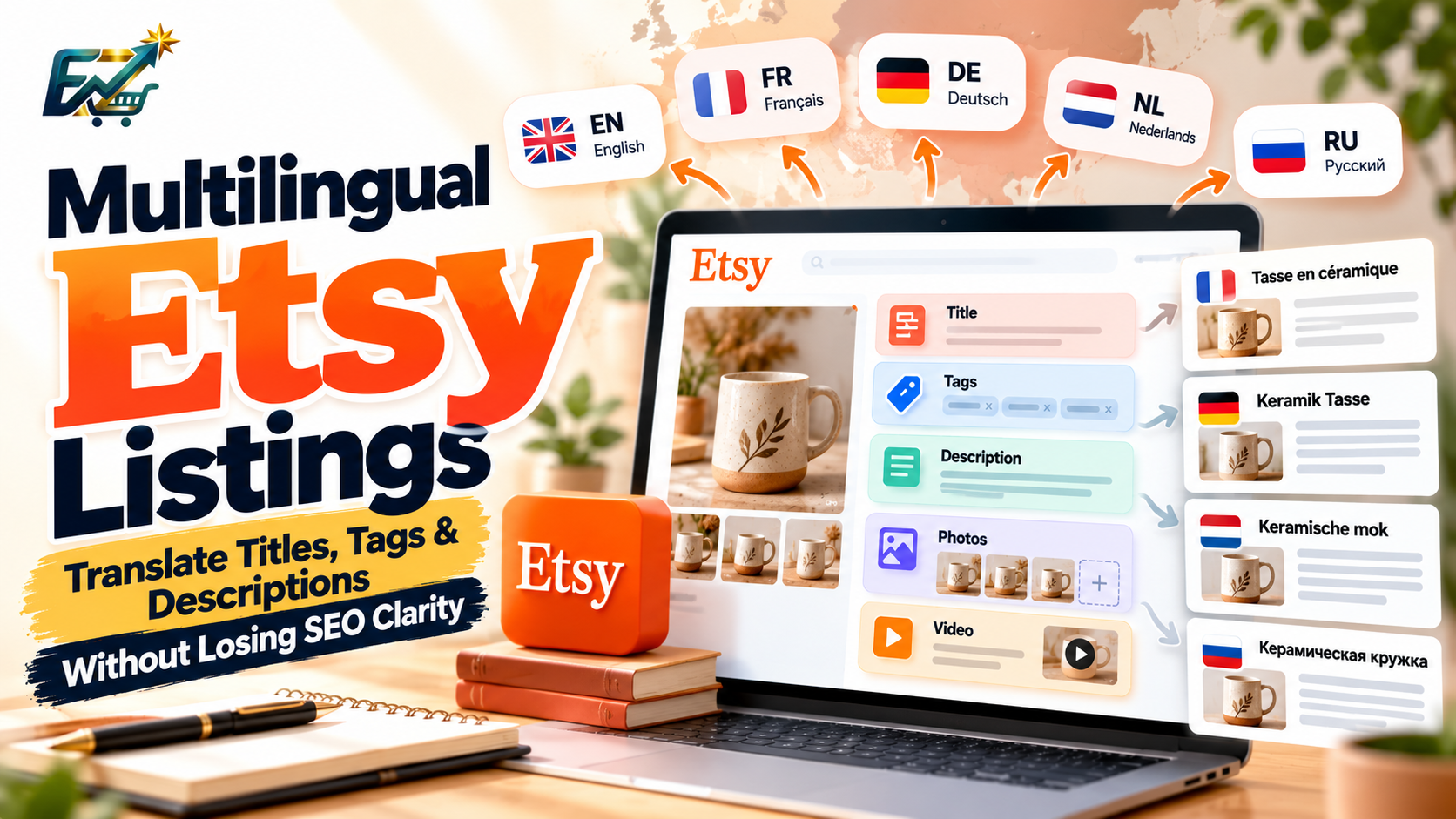
Translated listings help shoppers read your product in their language when Etsy's translation tools and your own translated fields support it. Translation is not a one-time SEO switch. The product meaning has to stay accurate, the local phrasing has to sound natural, and you should confirm Etsy's current shop and listing translation steps before you publish.
If you sell internationally, start with your best-selling or most promising listings. You do not need to translate the whole catalogue on day one.
Should you translate Etsy listings?
Yes, when you can write accurate translations and support buyers in those languages. Etsy offers automatic listing translations and lets sellers add manual translations for supported languages. Your own text gives you more control over the title, tags, and description.
Etsy's Help Center says manual translations can override automatic ones. The Seller Handbook recommends writing the original listing in the language you know best, keeping that default language consistent, and adding manual translations only for languages you can use confidently. The steps are in How to translate your shop and listings.
Translation does not guarantee search placement, visits, or sales. The goal is a listing that is clear and relevant in the target language.
A practical start:
- Pick a small group of important listings.
- Translate the title, tags, and description.
- Check product words with a fluent speaker or a careful language review.
- Confirm shipping, personalization, and product details match the original.
- Publish, then watch buyer questions and how those listings perform.
How Etsy shop and listing translation works
Automatic translation and manual translation do different jobs.
Automatic translations
Etsy can translate listing content for shoppers who browse in another language. That reaches people without a hand-written version of every listing.
Automated text can miss a product name, a regional phrase, or a small difference in meaning. Clear original copy gives both you and the automatic system a better start.
Manual translations
Etsy lets you manually translate a listing's title, description, and tags. Categories and attributes are translated automatically, according to Etsy Help.
Etsy currently points sellers through this path:
- Open Shop Manager.
- Go to Settings, then Languages and translations.
- Choose Manage languages and turn on languages you can support.
- Open a listing and find Translations.
- Add the translated title, description, and tags in the matching language fields.
The screens can change. Follow the current translation instructions.
You can also translate shop text such as the announcement, tagline, sections, About content, and some policies. Check which fields your shop settings actually show.
Write the default language well
Etsy recommends creating the original listing in the language you know best and keeping that language consistent across listing fields and shop details. Mixing languages in the default title, tags, and description can confuse translation.
Two handbook notes cover the current advice: Tips for optimizing your shop's language settings and Grow your buyer base by adding your own translations.
What to translate first
1. Translate the title
The title should name the product naturally in the target language. A word-for-word pass from English often sounds awkward.
A personalized ceramic mug may need different word order in French and in German. The translated title should still say what the item is, that it can be personalized, and which traits matter. Put the product near the start. Do not repeat phrases just to fill the character box.
Translated titles still have to fit Etsy's title limit. The current published cap is 140 characters, including spaces. See Etsy listing limits and How to write Etsy titles that get found.
2. Localize the tags
Tags need the phrase a local shopper would type, not a dictionary swap of each English word.
An English gift phrase may not match what French or German shoppers search. Look for natural product names, gift terms, materials, and use cases. Translate the intent. Do not add an unrelated popular term because it sounds busy.
Each tag still has a character cap. Etsy's Keywords 101 guidance allows up to 13 tags of up to 20 characters each, and spaces count. A natural phrase that is too long needs a shorter local version, not a cut-off word. The Etsy tags guide covers how to choose phrases.
3. Translate the description
The translation should answer the same questions as the original. It should not add claims or drop conditions.
Check that it still explains:
- What the product is and what the buyer receives.
- Materials, dimensions, colors, and variations.
- How personalization works and what the buyer must send.
- Processing time, shipping, and delivery expectations.
- Care, returns, or other policies that apply.
Use plain sentences. Skip jokes and wordplay that will not survive the language. Structure notes are in How to write Etsy descriptions.
4. Review attributes and categories
Etsy's translation guidance says categories and attributes are translated automatically. You still choose the values, and those values have to describe the real product.
Do not pick an attribute because the translated label looks like a useful keyword. The fact has to stay true in every market. The attributes guide is the longer version of that rule.
Notes for French, German, Dutch, and Russian
No language automatically ranks better on Etsy. The useful language is the one your buyers search in, for this product.
SEOLister can draft listing copy in languages enabled for the shop, including English, French, German, Dutch, and Russian. Before you publish, confirm those languages in your Etsy language settings, and make sure you can answer buyers in any language you turn on.
English: make the source listing clear
If English is the default, make it the clearest version before you translate. Use accurate product words. Keep other languages out of the default title, tags, and description. A clean source is easier to compare with each translation.
French: use product words people actually say
French word order, product names, and gift phrasing often differ from a literal English line. Check accents, agreement, singular and plural, and the exact personalization instructions.
German: check compounds and details
German product terms often join words differently from English. A direct translation can be understood and still sound wrong. Review compound nouns, capitalization, gender, and the terms buyers use for this item. Dimensions, materials, and personalization should stay unambiguous.
Dutch: keep it direct
Review word order and everyday product terms. Leave an English word in the Dutch text only when your buyers already use that word for the product. The description should read like product information.
Russian: review endings and buyer-facing lines
Russian needs attention to grammatical forms, word endings, and natural phrasing. Product names, materials, and personalization instructions are the lines to re-read. If you publish in Russian, you need a way to reply accurately in Russian.
For every language, localize the search phrase, keep the product meaning, and read the final text. A translated keyword is not proven demand.
From the base listing to published translations
Step 1: Choose the first listings
Start with products that already matter: steady sales, repeated buyer questions, or a listing you are about to push. A small pilot shows repeated terminology problems before you scale.
Step 2: Finish the source listing
Check the original title, tags, and description. Confirm the product name, materials, measurements, variations, and personalization. Fix unclear source copy first, or the same mistake lands in every language.
Step 3: Draft each field on its own
- Title: name the product and its key traits.
- Tags: use phrases local shoppers would type, inside the character cap.
- Description: explain the product, options, and conditions.
Keep a short glossary of product names, materials, and terms you repeat. That keeps later listings consistent.
Step 4: Review every language
A translation tool can draft. The version you publish still needs a read. A fluent speaker who knows the product category is the strongest check. If you do not have one, compare each field to the source and look up terms you are unsure about.
Step 5: Publish, then keep the translations current
Put each translation in the matching Etsy language field. Preview it where Etsy shows the translated listing.
Update translations when price, specs, personalization, processing time, or shipping changes. An old translation can be wrong even when the source listing is current.
The wider listing plan is in the complete Etsy SEO guide. Shop setup beyond one listing is in the Etsy selling guide.
Mistakes that weaken translated listings
Trusting machine translation alone
Automatic translation helps shoppers get the gist. It can miss local product words and the tone you want. Read manual translations before you rely on them for an important product.
Mixing languages in the default fields
Do not drop French or German keywords into an English title or tag to "cover" another market. Keep the default fields in the default language. Use the translation fields for the other languages.
Translating keywords word for word
A correct dictionary line may not be what shoppers type. Check local wording, and ask a fluent speaker when you can.
Letting shipping and personalization go stale
The translation has to describe the same item, the same delivery terms, and the same personalization steps. Recheck measurements, units, processing time, shipping, and returns.
Translating the whole shop before you test
A large batch is hard to review and hard to maintain. Start small, lock the quality steps, then add listings you can keep accurate.
Treating translation as a ranking guarantee
Manual translations can help shoppers understand a relevant product. They do not set your search position or your sales. Keep reviewing listing quality and buyer questions.
How SEOLister fits
SEOLister drafts titles, tags, descriptions, styles, and materials from product photos. It can also draft that copy in languages enabled for the shop, including English, French, German, Dutch, and Russian. You can review a completion checklist, reuse templates and snippets, make a listing video from photos, and publish to a connected shop after you approve the draft.
Use the draft to move faster. Then check wording, product facts, and local phrasing before anything goes live. Current workflows are on the features page. Plans are on pricing. The completion score is SEOLister's checklist. It is not Etsy's search score, and it does not guarantee rank or sales.
The create flow is in Create a new Etsy listing. Tool comparisons live on the alternatives pages. Single-field drafts are in free Etsy tools. Newer shops can start with Etsy SEO for a new shop and Best Etsy SEO tools.
Sources
- Etsy Help: How to translate your shop and listings
- Etsy Seller Handbook: Tips for optimizing your shop's language settings
- Etsy Seller Handbook: Grow your buyer base by adding your own translations
Etsy's translation screens and supported languages can change. Confirm the fields in Shop Manager before you publish. SEOLister is not affiliated with Etsy, Inc.
Frequently asked questions
Should I translate my Etsy listings into French and German?
Translate them if you can describe the product accurately and support buyers in those languages. Start with a small set of important listings and review product terms before you publish. Translation does not guarantee higher rankings or sales.
Does Etsy automatically translate listing titles, tags, and descriptions?
Etsy can show automatic translations to shoppers, and sellers can add their own translations. Etsy Help says you can manually translate the title, description, and tags. Categories and attributes are translated automatically. Check the current Shop Manager screens, because the path can change.
Are manual Etsy translations better than automatic translations?
Manual translations give you more control over product words and tone. Etsy's Seller Handbook recommends adding your own translations when you can represent the item and help customers in that language. A draft still needs a careful read.
Should I put French or German keywords in my English Etsy tags?
Keep the default title, tags, and description in your shop's default language. Use Etsy's translation fields for other languages instead of mixing languages in the default fields.
Which languages does SEOLister support?
SEOLister can draft titles, tags, and descriptions in languages enabled for the shop, including English, French, German, Dutch, and Russian. Review the wording, and confirm the languages Etsy currently lets you publish in Shop Manager.
Do multilingual Etsy listings guarantee better search rankings?
No. A translation can make the listing understandable in another language. It does not guarantee a search position or more sales. Accurate details and natural local phrasing still matter.
How many listings should I translate first?
Start with a small group of important listings that already have stable specs. Review those translations, then expand once the wording and the upkeep are manageable.
Related articles

Etsy SEO
How to Write Etsy Titles That Get Found in 2026
Titles that sound clever but never rank? Learn keyword placement shoppers actually type so your listings show up before competitors do.
Etsy SEO
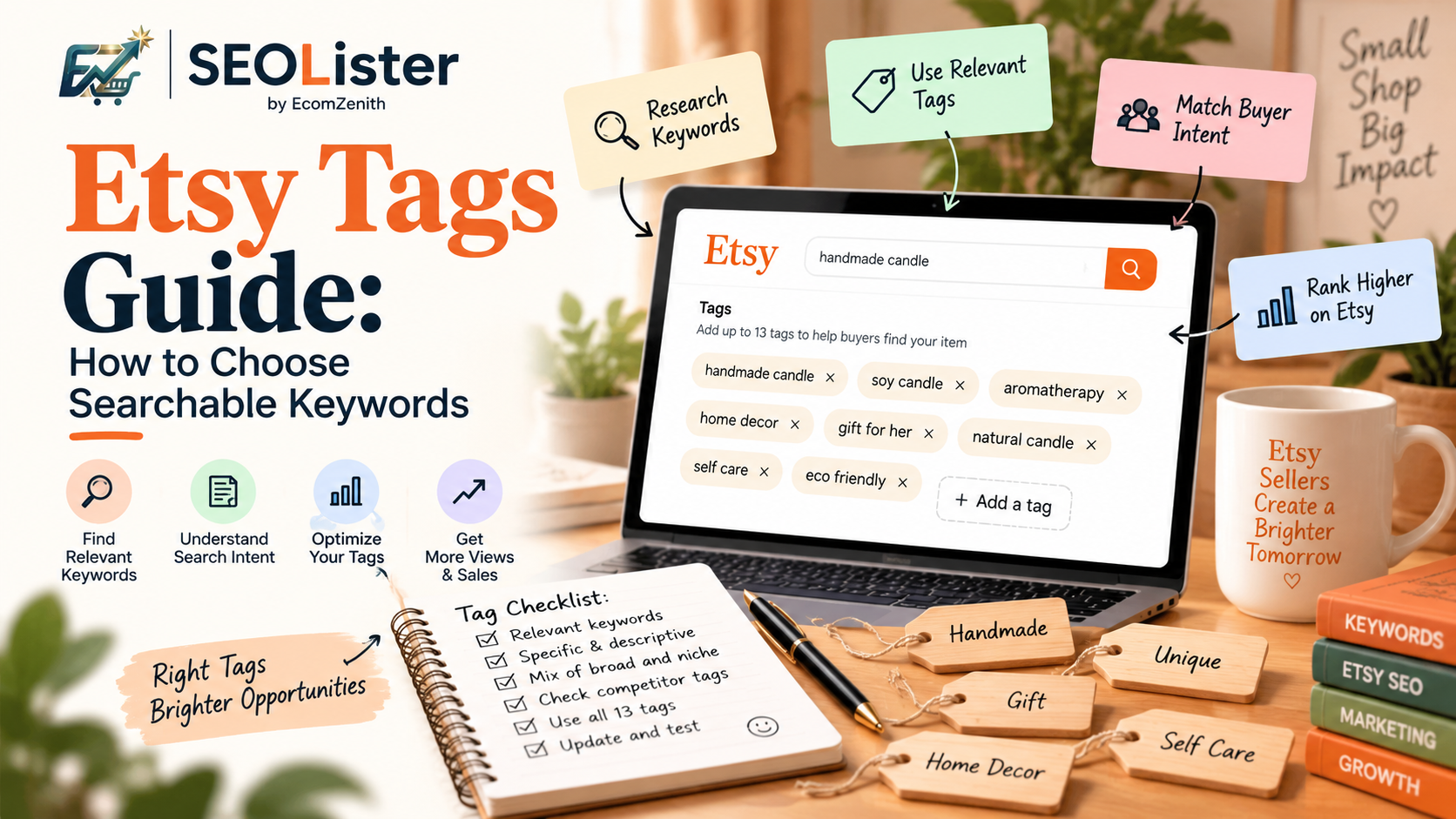
Etsy Tags Guide: How to Choose Searchable Keywords
Learn how to choose all 13 Etsy tags using specific, buyer-focused search phrases that can help your listings match relevant Etsy searches.

Etsy SEO
How to Write Etsy Descriptions That Sell (Not Keyword Walls)
Learn how to write Etsy product descriptions that explain features, materials, and use cases—supporting SEO and buyer confidence without keyword stuffing.